The Greeting Card or the Handwritten Letter?
Greeting card or handwritten letter: choose the form that suits your message, from a quick occasion greeting to a personal note that needs room to unfold.
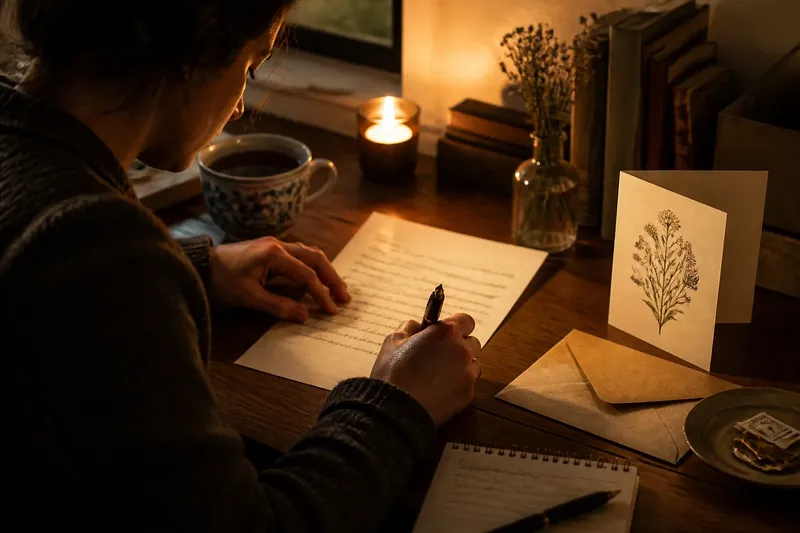
A greeting card gives a personal message a frame; a handwritten letter lets the message make its own shape. If you are weighing a greeting card or handwritten letter, start with what you want the recipient to feel as they open it: recognised within a familiar occasion, or invited into a more open conversation.
Neither form is inherently warmer. A card’s printed design and brief text can make affection easy to express without a long preamble, while a letter’s open page can hold changes of subject, remembered details and pauses. The choice is less about which object is more meaningful than about which one gives your particular message the right tone, space and pace.
What does a greeting card signal before anyone reads it?
A card announces its occasion at a glance. A birthday illustration, a seasonal motif or a simple blank front sets an expectation before the envelope is opened, giving the recipient a clear clue about why you are writing.
That visual frame can be helpful when the relationship is affectionate but the words do not come readily. The design supplies a starting mood, and the printed message may supply a familiar phrase you can answer, adapt or leave untouched. A card need not feel impersonal: a handwritten name, a specific sentence inside, or a small note in the margin can distinguish it from a shop-bought greeting sent without thought.
The frame also narrows the message. A card marked for congratulations may make a long account of unrelated worries feel out of place, while a sympathy card may call for restraint rather than lively anecdotes. If the occasion is the main reason for writing, that narrowing is often useful; it helps the note stay focused on the person being recognised.
Look at the whole card before choosing it, not only the front. A humorous image paired with a solemn printed verse can pull in conflicting directions, and a sentimental message may not suit a relationship that usually relies on dry humour.
When is a handwritten letter a better fit?
A letter suits a message that needs room to move. You can begin with one thought, shift to a shared memory, ask a question and return to the first subject without trying to make every sentence fit a printed prompt.
That freedom can bring a more conversational tone, but it also asks the writer to decide how the message begins and where it ends. A first line such as “I kept thinking about our walk by the river” gives the recipient a particular scene to enter; a broad opening such as “I have so much to tell you” may leave the page feeling as if it is waiting for a plan.
Letters can also make room for complicated feelings. You might want to offer congratulations while acknowledging that the recipient has had a demanding year, or explain why a small shared moment stayed with you. In a letter, those ideas can sit beside one another without the occasion’s printed wording dictating the order.
Choose a letter when the content matters more than a ready-made visual cue. It does not need to be long: a short note on plain paper can still feel open-ended because its language comes entirely from you.
How do the two forms change the pace of a message?
A card tends to be read as a compact gesture. The recipient sees the design, opens the fold and reaches the words in a short sequence; the format suggests that the message has a contained beginning and end.
A letter often takes longer to compose and invites a slower reading, especially if it includes several paragraphs or a detail that rewards a second look. The reader can pause, return to a line and keep the page nearby. That does not make every letter profound or every card fleeting; it simply gives each object a different rhythm.
The writing pace matters too. A card can be completed in one sitting because its boundaries are visible. A letter may gather its shape through revision: you might cross out a line, add a question in the margin or move a thought to a fresh paragraph. If you are writing under time pressure, choose the form that lets you be clear without forcing the message into a rushed performance.
Imagine you want to thank a neighbour for bringing soup while you were ill. A card could carry a direct thank-you and a warm closing, making the gesture easy to receive; a letter could explain which small kindness mattered and ask how the neighbour’s own week is going. The expected difference is visible in the message itself: one ends as a concise expression of thanks, the other opens a thread for conversation.
How much space should the message take?
Use the available space as a practical cue, not a target to fill. A card’s printed words may leave only a small area for your handwriting, while a folded sheet gives you room for a fuller account. Writing to the edge of a card can make the gesture feel crowded, so a concise message often suits its form.
Before you write, decide what the recipient most needs to hear. For a card, that might be the occasion, one specific reason you value the person and a closing that sounds like you. For a letter, it might be the same elements plus context, a memory, or a question that invites a reply.
If you have more to say than the card allows, you do not have to cram smaller writing into every gap. You can add a separate note, or choose a letter instead. Conversely, if a letter seems daunting, begin with one scene or detail and let that carry the message; a personal note is not improved simply by being longer.
Leave a little breathing room around the words. On a card, that means allowing the design and printed message to remain legible; on a letter, it means separating ideas into paragraphs rather than making one dense block. White space is part of how the recipient reads the message, not wasted paper.
What should you write inside a card or letter?
Write a detail the recipient can recognise as belonging to your relationship. “I still smile when I think of your terrible pun at the station” carries more individual texture than a general statement of appreciation, provided the joke is one the two of you share.
For a card, keep the structure simple if that helps you start: name the occasion, add a specific thought, then close in your usual voice. You can ignore a printed verse if it does not sound natural, or respond to it with a sentence of your own rather than repeating its sentiment.
For a letter, give the reader a path through the page. Begin with the reason you thought of them, follow with the details that matter, and finish with a question or a clear sign-off if you want to continue the exchange. You do not need to report every event since you last spoke; select what might interest this recipient.
Handwriting does not need to be decorative. Use a pen that writes cleanly on the paper, leave enough space for the address if you are mailing it, and reread the note for names and dates that could be misunderstood. The aim is legibility and a recognisable voice, not calligraphy.
Which form suits a particular occasion?
A card often fits an occasion that already has a shared script: a birthday, a new home, a recovery, a condolence or a seasonal greeting. Its design can signal the moment, while your own words make the gesture personal.
A letter may suit a quieter reason for contact: catching up after a long silence, explaining a decision, or telling someone how a memory has stayed with you. Because it does not depend on a printed occasion, it can arrive on an ordinary day and give that day its own point of attention.
Some situations can take either form. A letter can express sympathy with care if you have a particular relationship to describe, while a card can hold a substantial personal message if its interior has room and the printed text does not crowd your words. Consider the recipient’s circumstances and the relationship between you, rather than treating one format as automatically more serious.
If the message concerns distress, conflict or a sensitive change, choose the form that helps you be precise and kind. A card’s shortness may prevent an emotional note from becoming overwhelming; a letter may be better if context is needed to avoid a blunt or ambiguous line.
How do you choose between a greeting card and a handwritten letter?
Is a card less personal than a letter?
No. A card can feel personal when its design suits the recipient and your handwritten words refer to something specific between you. The format is only one part of the gesture; attention to the person is what makes the note individual.
Can you put a letter inside a greeting card?
Yes, if the card’s message and design fit the occasion and the separate note gives you room for more. Keep the card’s own inscription brief, then use the letter to add context or continue the conversation.
What if you do not know what to write?
Start with one concrete reason you are writing, then name a detail you remember or appreciate. If the message still feels difficult to shape, a card can provide a prompt; if the thought keeps branching, a letter gives it room.
Should a handwritten message be long?
No. A short letter can be complete, and a long card can become hard to read if it overwhelms the available space. Let the message stop when you have said what you meant and given the recipient a clear sense of your attention.
How can you make the choice feel natural?
Try saying the first sentence aloud before selecting paper. If it sounds like a direct greeting tied to a shared occasion, a card may carry it well; if it starts a story or needs explanation, a letter may be easier to shape. This is a prompt, not a rule: the best choice is the one that lets the words sound like yours.
Think about how the recipient is likely to encounter the message. A card may be displayed with other greetings or kept in its envelope; a letter may be folded away and reread. If you want the note to be easy to notice on a busy day, a clear card can help. If you want to leave a longer account to be read at the recipient’s pace, write a letter.
You can also use both forms without making the gesture elaborate. Send a card for the occasion and include a separate note only if there is something important that the card cannot hold. The second piece should add a distinct thought, not repeat the same message in a different format.
For a greeting card or handwritten letter, make the final decision by matching the shape of the message to the space it needs. A card frames a moment; a letter lets a thought unfold. The useful question is not which object carries more feeling, but which one will make your particular words easiest to receive.